Spherical Rotation
Wheeler and Feynman said there are waves going out from an electron — forwards in time and backwards in time. But to me, waves going out backwards in time are really waves coming in forwards in time. It’s simpler to imagine waves coming in, passing through the centre, and coming out again. They were close to getting this correct, but they didn’t take the final step, which is to say that this is not something that happens to an electron — this is the electron.
Wheeler and Feynman even mentioned this in one of the main physics textbooks used in America. It explains the property of spin-half: you have to rotate something twice to get back to the same position. Many particles have this spin-half property. Milo Wolff went further and proved that this explains all the properties of an electron
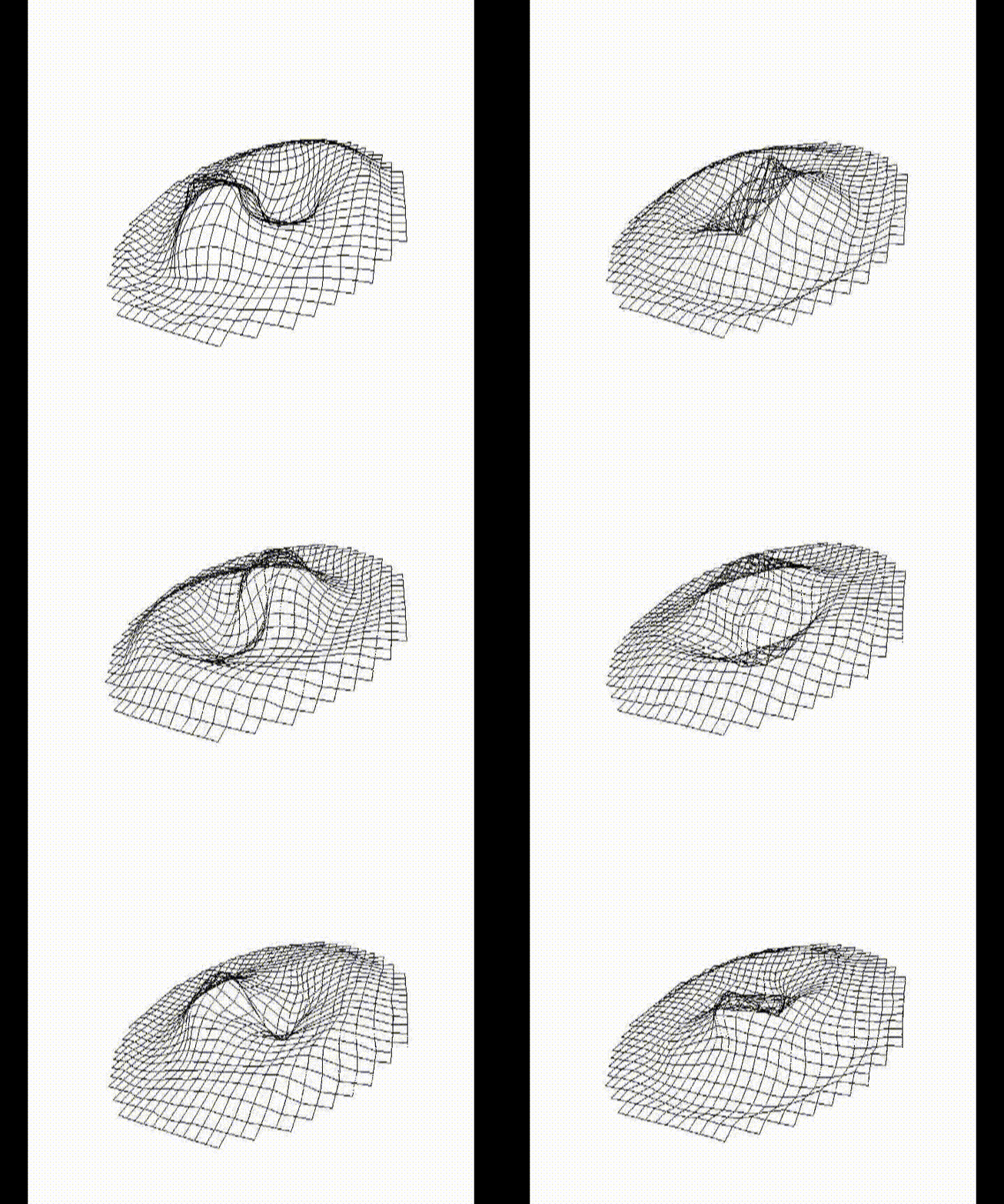
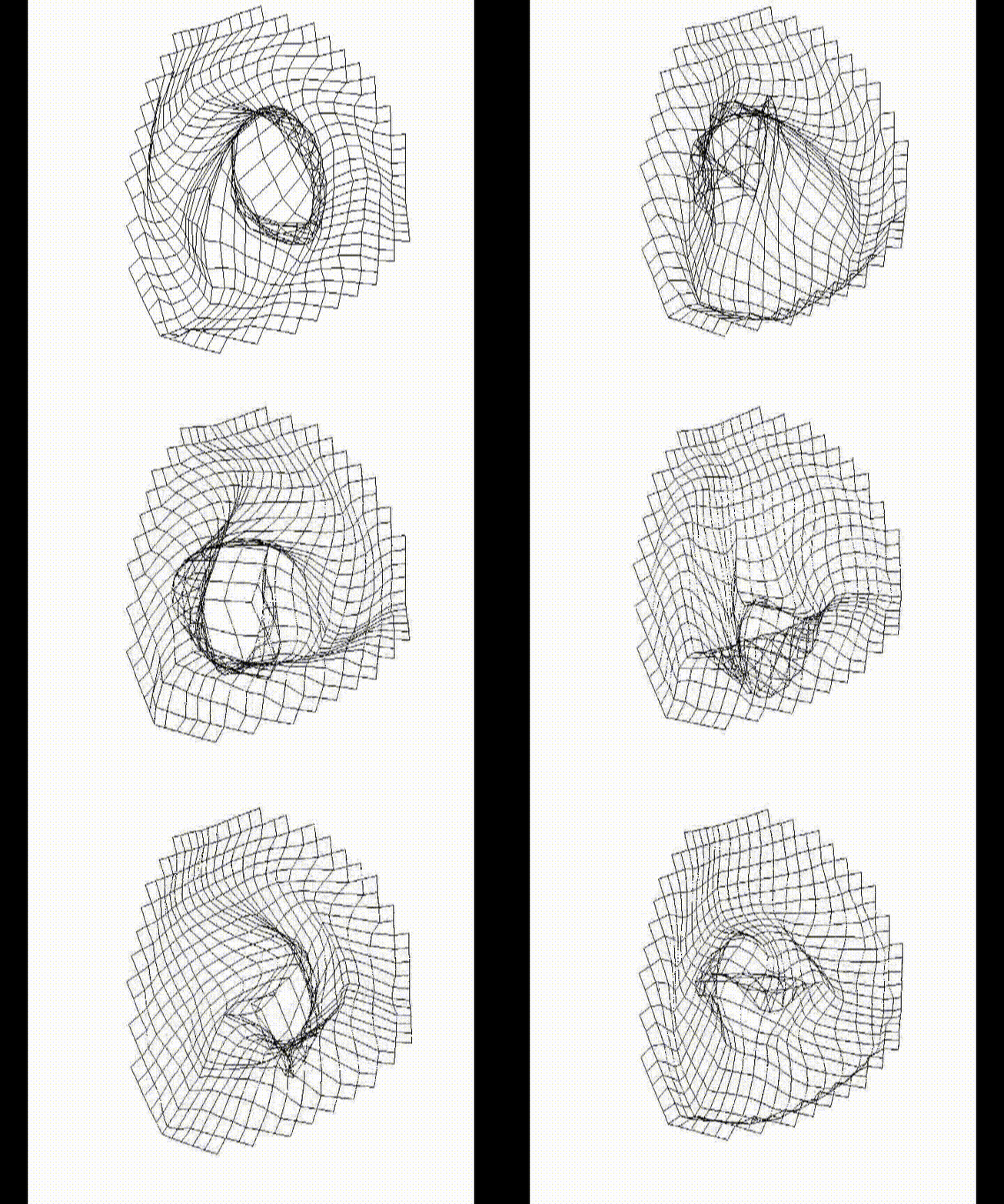
This is what I call the “wobbly project”. It tries to represent that sphere rotating in space, but what I’ve shown here is a slice through it. You can see something going around clockwise, with up and down motion. There’s actually a whole 3D structure around this, which is difficult to follow, but you can get the idea that there is circular motion, with waves going outwards.
Here’s another view: instead of one slice, I did three slices intersecting at a corner. You can see the three axes at right angles. It’s all consistent with Milo Wolff’s description, but he wasn’t the first one to look at this.
When that thing starts, the initial position is like a ball with strings going up, down, left, right, forwards, and backwards. Then you rotate the ball 180 degrees and spin it. It looks like the strings would get tangled, but they don’t. Of course, it’s not really strings; if we think in terms of the ether, there is substance everywhere. Imagine a block of jelly being twisted and spun — it doesn’t tear apart, it just tangles and untangles.
Join us on a fascinating journey into the previously secret structure of the world around us and within us in Wobbly Universe, a full colour 360 page book in hard and soft cover.

This book presents the Harmonics Theory, a new explanation for the structure and rhythms of the universe. This theory reveals a single, elegant principle that connects phenomena across all scales, from the vast superclusters of galaxies to the vibrations of atomic particles. It applies equally to the slow cycles of geology, the faster pulses of economics, and the rapid oscillations within cells, molecules and atoms in our own bodies. In essence, it seeks to explain the relative distances and time scales that define our reality. No other physical theory does this.
The Harmonics Theory contends that this grand architecture is the result of a pattern of harmonically related wave structures. This pattern is predictable from a simple principle that is fully compatible with standard physics, yet the final picture it produces goes considerably beyond present scientific teaching. This theory establishes a new domain of physics, akin to how Boltzmann's gas theory did, and it promises to launch many new areas of study. Harmonics Theory is an entirely new domain and stands apart, like General Relativity or Quantum Mechanics. In fact, along with those two, it is the third limit of the Universe as shown on the Three Limits diagram on the back cover.
In order to achieve the primary purpose it is first necessary to give a background of information from many different areas of human knowledge. While rather uncommon today, the study of cycles has been pursued by a small group of researchers who discovered a subtle, periodic wave nature underlying our everyday experience. Specialists in astrophysics, geology, cosmology, health, physics, economics, astronomy, geophysics, biology, botany, zoology, demecology, climate and weather, history and wars have all found cycles in their domains, yet few have realized that solid, scientific relationships connect these many diverse phenomena.
We will therefore journey through this little-known but well-established knowledge, as it is essential to do this in order to appreciate the power of the Harmonics Theory. This story of cycles discoveries is fascinating in its own right. Just one or two examples will hopefully amaze you and make you think. Many people know that there is an 11 year cycle in the number of sunspots on the Sun, however it is not at all well known that when the sun is around the maximum of this cycle there is generally a considerable increase in the number of wars on Earth. This is not a new finding but has been known for many decades and yet is still not in the common knowledge pool. Another example is that the average rate at which blood sediments in a centrifuge varies considerably over a few weeks and in the same way all over the world indicating some cosmic influence. Blood sedimentation also oscillates with a 3 minute cycle which may be solar in origin. These are not mere coincidences but clues to a deeper order in nature.
Please enjoy,
Ray Tomes
October 2025